
I apologize for the lack or material lately, but I am on the move. And, of course, looking for pencils in Catalonia!
I apologize for the lack or material lately, but I am on the move. And, of course, looking for pencils in Catalonia!
Before I was a pencil nerd, I was a film photo nerd. Taking photos on film was my original analog pleasure. Of course, I remember when I was a kid and all photos were taken on film. Then things started going digital when I was a teen in the late 90’s and early 00’s and I was quick to jump onboard, first by getting my film scanned to CD rather than prints, later by buying a scanner so I could have the “best of both world”, then finally by becoming the first among my friends to own a digital camera. Eventually things kind of came full-circle in the 2010s. At one point I noticed that people had started putting bad filters on digital photos to make them look more like film. It kind of hit me how silly it is to make poor imitations of film photos when I can just take photos on film to begin with. (Believe it or not, I’m going somewhere with this).

So, even though pencils are my latest analog nerd craze, film photography has a special place in my heart (and as an aside, the lack of good sunlight for taking blog photos now that it’s winter in Alaska is killing me, so please excuse the crappy office lighting in these pics). Needless to say that when I saw the Deli 668 sharpener — cleverly disguised as a small twin-lens reflex camera — I kinda had to have it. But, cuteness aside, is it a viable replacement for the Deli 610 or the Carl Angel 5? That was the question on my mind as I dug in for this review.
Continue readingAnother Bonanza find: three vintage Eberhard Faber Mongol No. 2 pencils.

Not sure what era they are from. I’m a little bummed they don’t have the “woodclinched” designation. Nonetheless, be on a lookout for a throwback review of ol’ 482 sometime in the future!
One of my constant fears since starting to go full-steam on this blog has been that eventually, some day, I’ll run out of pencils to review. Let’s do the math: if I average a pencil review per week, that’s about 50 different types of pencils a year. It seems like I’m on pace to exhaust the possibilities within a few years; or at least the easy ones. I feel like I’ve already picked a lot of the low-hanging fruit.

Needless to say, I was excited when I walked into a local chain-brand supermarket and found something I’d never seen before. Just this fall, a company called Written Word Pencil Co. has started putting out several lines of USA-made pencils that they’ve branded America’s Finest. I eagerly snagged the two versions available — naturally-finished “American Arbor”, and accurately-named “Prestige Black” — to have a look a closer look at them.
Continue readingGlad to see I still have some readers after falling off my blog posting schedule. I had a work training all of last week, followed by some much-needed disconnecting, so my daily routine has gone out the window for the past week or two. I’m back, though! Look for a new pencil review in the next day or so.

In the meantime, here’s some Alaska porn. The Polar Pencil Partner and I hiked in to the Manitoba cabins (not really much of a hike — just enough to feel like you’re “off the grid” but definitely not hard to access either) to celebrate our anniversary. I was pleased to find a pencil cup (although the pickin’s were slim), a Boston rotary sharpener, and the old-school leather-bound log book.
Next time I hike into a cabin, I’m going to take a few good pencils with me to stock it up. They’ll call me Jesse Pencil Seed.
Recently, I published a review of a Thai pencil made in China (the Masterart Wood 2B). So, it seemed like the natural next review would be a German pencil made in Thailand. Perfect timing, because a package of Staedtler Norica pencils just arrived in the mail!
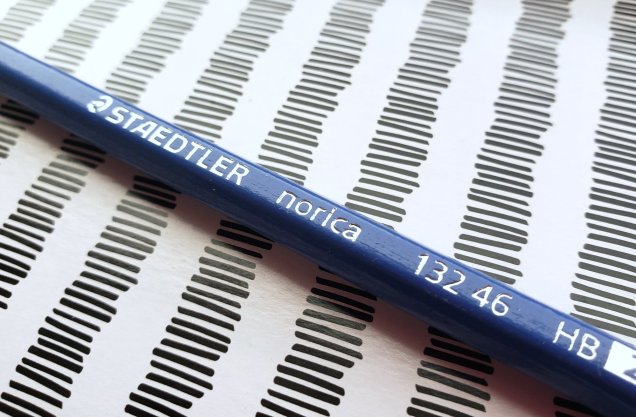
Staedtler is known among pencil nerds for its venerable Mars Lumograph line of high-end graphite pencils. On the other end of the spectrum are products such as the Rally, marketed toward more of the general-purpose, use-it-and-lose-it crowd. The Norica seems to sit somewhere in between: a pencil geared for the typical everyday writer who wants an upgrade in quality without splurging on a fancy drawing pencil. Let’s see how well it fills that niche.
Continue readingA lot of people already know this, but “they pay people to live in Alaska”. I use quotation marks, because that’s a really bad way to explain it. What actually happens is that the State invests a portion of its oil royalties in a sovereign wealth fund composed of stocks, real estate, etc. The annual earnings of the fund can be reinvested, appropriated to finance the State budget, and disbursed as a dividend. Anyone who has been a resident of Alaska for a year or more with the intention of staying indefinitely can apply in the spring to get the year’s dividend, which is paid out in October.

Anyway, what that means for you is that I have slightly more disposable income than usual this month, and the first wave of my writing-supply spurge is flowing in!
I haven’t reviewed a pencil from India in a minute, so I’m glad that my box of Doms X1 pencils came in. Actually, another one arrived a few days ago…not sure why I ordered two. Oh well! Also I snagged the Maped Black Peps, as you can see, which is a pencil that’s just been kind of hanging around in my Amazon wishlist for a while. The price dropped like ridiculously low, so I bit. And, that Tops composition book…let’s just say I have a little composition book post in the works. Maybe even a series of posts.
I’ve got a lot more stuff coming, so stay tuned for more reviews and general pencilly goodness.
I often memorialize the victims of the Rubbermaid Pencil Massacre on this blog, but I have yet to give a proper eulogy to one of its most prominent: The Eberhard Faber company of Brooklyn, USA. Thankfully I managed to acquire an example of one of their products from a thrift store grab bag, and have decided to give that lone pencil — the American EcoWriter in No. 2 grade — the Throwback Pencil Review treatment.

Back before the aforementioned mega-merger, Eberhard Faber produced more than one third of the pencils made in the United States. Shortly before they met their demise, in the early 1990’s, they began experimenting with ways to make a more earth-friendly pencil. One such experiment was the EcoWriter, a “wood substitute” pencil made not of extruded plastic, like many others (sidenote: did people really used to think that disposable plastic products were good for the environment?), but rather some amalgamation of recycled paper and cardboard. Pencils using this construction method can occasionally be found in current production, but it seems that the EcoWriter was the first to take a stab at it — or at least the first attempt by a major manufacturer to bring it to the masses.
But let’s address the elephant in the room: was the EcoWriter actually any good?
Continue readingA while back I took the Paper Mate Mirado Classic — which I did not expect to actually enjoy — for a spin and found it to be quite a nice little pencil. But the fun doesn’t stop there, because that unassuming little schoolhouse-yellow, office-desk-drawer-inhabiting pencil has a slightly more adventurous sibling: the Mirado Black Warrior.

The Black Warrior is one pencil which, under one brand name or another, has been around for quite some time. It was part of the Eagle family prior to 1969, when the company was bought by Berol; it then passed hands to Sandford and eventually the Newell-Rubbermaid conglomorate that makes pencils under the Paper Mate brand. Somewhere along the line, it got coupled up with the Mirado pencil to become the Mirado Black Warrior, and here we are. The classic iterations of the pencil have been a favorite of numerous writers over the years, but how does the present-day version stand up? Let’s take a look at it and see.
Continue readingWe all love the humble but might composition book. But, have you ever tried a Decomposition Book? Michael Roger, Inc. has engaged in a little bit of witty wordplay with their well-known series of notebooks, the pages of which are made from 100% post-consumer-waste recycled materials.

Although the Decomposition Book started as a spin on the thread and tape bound comp book we all know and love, they’ve expanded into a full range of different sizes and formats. I thought I’d dip my toe into their products with a spiral-bound pocket-sized notebook that I picked up in Seattle (please excuse the wear on the book — it’s traveled 1,500 miles with me!) So now, after making the journey from the Emerald City to the City of Lights and Flowers, I’ve prepared my review.
Continue reading Polar Pencil Pusher